
There were reports of Iranian speedboats opening fire on an oil tanker in the Strait of Hormuz, after Tehran announced it would close the waterway until the United States lifted its port blockade.
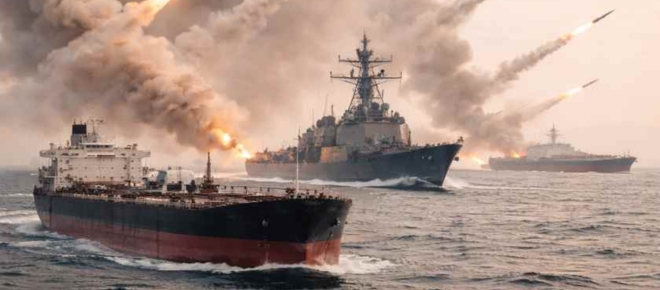
Iran has again closed the Strait of Hormuz, citing the US naval blockade of its ports as its response.
On Saturday, the Iranian military declared it had "reestablished control" of this strategically vital waterway, through which 20% of the world's oil trade passes. According to some sources, Iranian patrol boats opened fire on a merchant ship attempting to pass through the strait.
The final shot was produced only a few hours after its reopening, during which time more than a dozen merchant ships passed through the sea route at the height of the 10-day fire traded by United States between Israel and Lebanon.
The Islamic Revolutionary Guard Corps (IRGC) said in a statement, cited by Iranian state media on Saturday, that the US blockade of Iranian ports constitutes "acts of piracy and maritime robbery." The statement also stated that control of the Strait of Hormuz is "under the strict direction and control of the armed forces."
"Until the United States restores full freedom of navigation for vessels traveling from Iran to their destinations and vice versa, the status of the Strait of Hormuz will remain tightly controlled and in its current state," he said.
By 10:30 GMT on Saturday, at least eight oil and gas tankers had passed through the strait, but at least as many vessels appeared to have returned after having begun leaving the Gulf, AFP reported.
India summoned the Iranian ambassador on Saturday to protest a "firing incident" involving two Indian-flagged merchant ships in the Strait of Hormuz, India's external affairs ministry said.
The ministry said in a statement that Secretary of State Vikram Misri summoned the Iranian ambassador and expressed India's "deep concern" over the incident.
According to the statement, New Delhi also urged Iran to "resume the process of facilitating the passage of India-bound vessels through the Strait of Hormuz as soon as possible." The envoy assured Iran that he would "convey these considerations to the Iranian authorities."
India was among the nations Iran designated as "friendly" and allowed several Indian-flagged vessels to pass through the Strait of Hormuz. Passage was also granted to vessels flying the flags of Malaysia, China, Egypt, and South Korea.
The dispute over the Strait of Hormuz has cast a shadow on US President Donald Trump's optimism the previous day, when he said that an agreement to end the US-Israeli war against Iran was "very close."
Trump celebrated the reopening of the Strait on Friday, but warned that US strikes would resume until Iran agreed to a deal that also included its nuclear program.
"Maybe I won't extend it," Trump told reporters aboard Air Force One, referring to the current temporary ceasefire agreement. "Then there will be a blockade, and unfortunately, we will have to start bombing again."
When asked if an agreement was possible in such a short time, Trump replied: "I think it will happen.
Iran, however, maintains that a date for a new round of peace talks has not yet been set and accuses the United States of "betraying" diplomacy during the negotiations.
According to John-Paul Rodrigue, a maritime expert at Texas A&M University, conflicting and evolving reports about the Strait of Hormuz and its relative freedom of passage have deterred many ships from attempting to pass through it.
"Since the announcement, several ships have attempted to pass through the strait, but many appear to be turning back due to the uncertainty of the situation," Rodrigue told Al Jazeera. "Conflicting information is spreading everywhere."
Al Jazeera correspondent Tohid Asadi reported from Tehran that "uncertainty reigns" regarding the Strait of Hormuz.
Iran is seeking a definitive end to the war in the region, security guarantees, the easing of sanctions, the release of frozen assets, the restoration of regional relations, and, furthermore, clarification on its nuclear program and its stockpile of highly enriched uranium, he said.
John-Paul Rodrigue, a naval expert at Texas A&M University, reported that the Strait of Hormuz was providing contradictory information and constantly changing course, thus jeopardizing society's freedom and defeating the objectives of many of the barges.
"After the announcement, the barges attempted to break the strike, but many were forced to leave due to the uncertainty of the situation," Rodrigue told Al Jazeera. "Conflicting information is being spread to all sides."
"Iran is committed to a final resolution of the conflict in the region, ensuring security, lifting sanctions, freeing frozen activists, restoring regional relations, and, furthermore, disclosing its nuclear program and valuable uranium reserves," he said.
Tensions remain high, and the situation in the Strait of Hormuz is still uncertain. While talks are possible, the risk of further conflict has not gone away.
.jpg)


.jpg)




Time: 03:47:50 AM Date: 2026-04-21
nice